More independent.Every month.
A structured, goal-focused NDIS pathway that builds the daily skills, routines and confidence you need to rely on yourself — and rely on others a little less. Same workers. Real-life practice. Progress you can actually see.
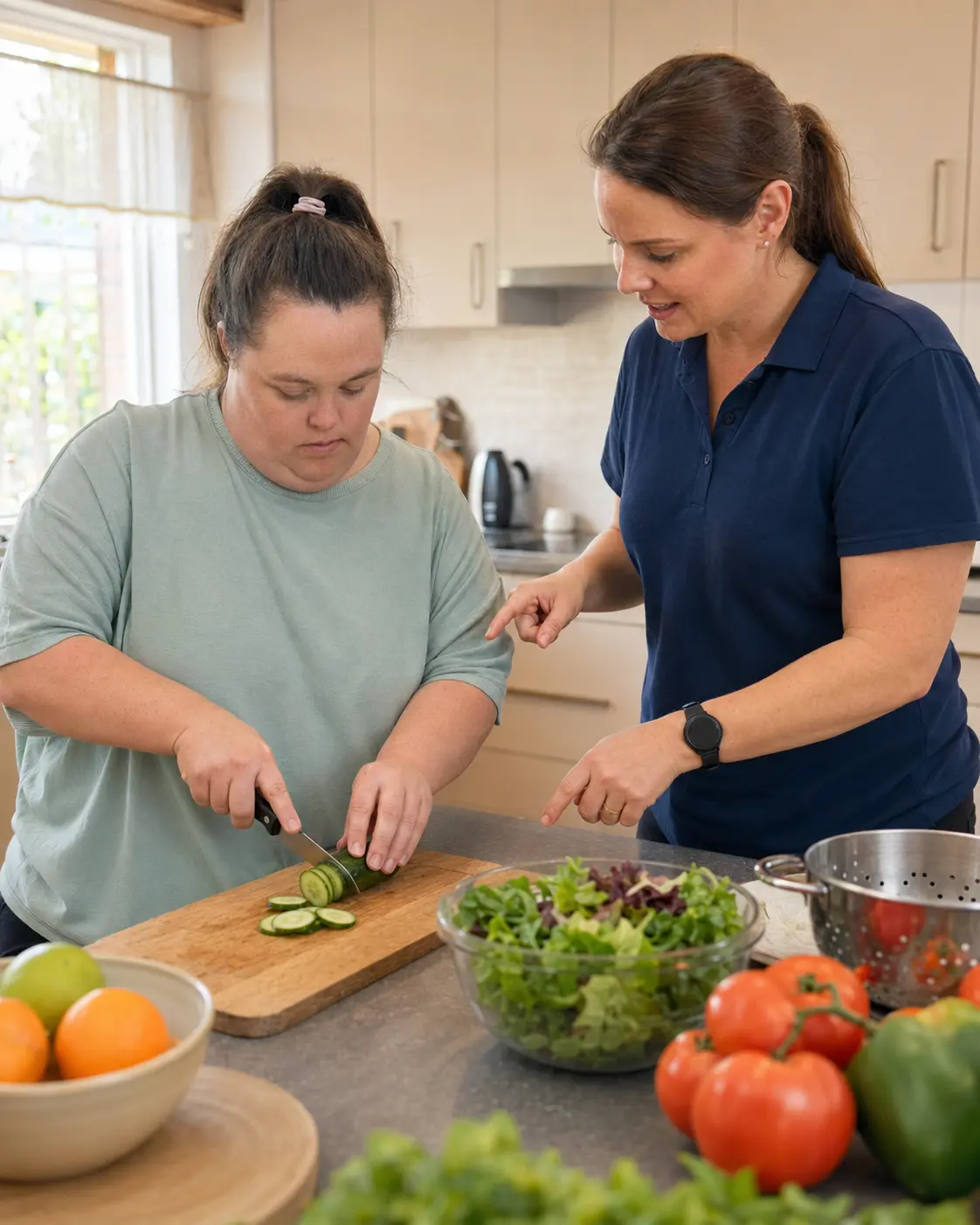
Imagine a life where… you don't need them for everything anymore.
Not instantly — progressively, with a consistent worker beside you who knows your goals, your pace and the way you learn best. This is what the pathway is built to produce.
- You manage your daily routine without someone prompting you through every step.
- You can cook a week of meals, budget your money, and keep your home the way you like it.
- You get to appointments and places you want to go — on your own, or with help you actually choose.
- You handle your own admin — the apps, the emails, the MyGov account — without it feeling impossible.
- You make more of your own decisions. What you eat, where you go, how you spend your time.
- Your family can step back — not because they stopped caring, but because you've got this.
- You're building something. Each month, you can do something you couldn't do before.
From “they do it for me” to “I've got this”
Most support keeps things ticking over. This pathway is designed to move you — from where you are now to somewhere genuinely more independent.
- ●A parent or partner still sorts your appointments, bills and admin.
- ●A different worker most weeks — you re-explain everything every time.
- ●Support workers do things for you instead of teaching you how.
- ●You've tried building routines before, but nothing has stuck.
- ●Travelling alone feels daunting, so you don't try.
- ●Your plan has capacity-building goals no one is actually working on.
- ✓You manage your own calendar, bills and MyGov — with systems that hold.
- ✓The same 1–2 workers who know your goals, your pace and your story.
- ✓You're taught how, you practise it, then it's genuinely yours.
- ✓Skills built in real life, at your real pace, until they stick.
- ✓You get where you want to go — with less support each time.
- ✓Every session moves a goal you can see measured, review by review.
Built for people who are ready to grow
This pathway is for you if…
- ✓You want more independence but don't know where to start.
- ✓You rely on family for things you'd like to manage yourself.
- ✓You're a young adult stepping into adulthood, or preparing for your own place.
- ✓You're autistic or have a psychosocial disability and thrive with routine and a consistent person.
- ✓You're rebuilding independence after a health event or a big life change.
- ✓Your NDIS plan has daily-living or capacity-building goals that aren't being worked on.
It may not be the right fit if…
- —You're in crisis right now and need acute clinical or mental-health intervention first.
- —Your primary need is high-intensity nursing or clinical care.
- —You'd prefer support workers to keep doing everything for you long term.
If that's where you're at, that's completely okay — call us anyway. We'll point you toward the support that actually fits, including our other services.
The real things that get in the way
These are what participants and families tell us — often after years of trying other approaches.
Here's the hard part: none of this stays still.
Every month a skill goes unbuilt, the gap feels wider and the routine feels harder to start. Family quietly take on more until they're stretched thin. And capacity-building funding that sits unused against your goals is exactly what can get trimmed at your next plan review — so the very budget meant to build your independence can shrink before it's ever used for that.
It doesn't have to keep going like this.
Four stages. One step at a time.
Each stage has a clear goal, specific activities and a defined outcome. You don't move to the next stage until this one feels solid — because rushing is exactly what makes skills not stick.
Discover
Understand where you are now
Build
Develop the core daily skills
Navigate
Confidence out in the world
Sustain
Lock in what you've built
Understand where you are now
- Independence assessment across six skill areas
- Goal mapping — what do you want to be able to do?
- Routine and schedule review
- Strengths — what already works for you?
- A conversation about how you learn best
Develop the core skills
- Meal planning, cooking and grocery shopping
- Home routines — cleaning, laundry, self-care
- Money and budgeting — bills, banking, your plan
- Digital skills — apps, email, MyGov, online safety
- Time management and tracking appointments
Build confidence in the world
- Public transport — Myki, routes, timetables, maps
- Travel training to appointments and activities
- Community participation tied to your interests
- Problem-solving in real situations
- Social confidence and self-advocacy practice
Lock in what you've built
- 30-60-90 day goal reviews with you
- Routine strengthening and consistency
- You leading more of your own decisions
- Fading support where confidence is established
- Deciding what comes next — new goals, or stepping back entirely
What your first 90 days can look like
This is an example of how the pathway typically unfolds — a composite, not a specific participant. Everyone's plan and pace are different, but the shape of the journey is the same: small, real wins early, then steadily fewer hands holding yours.
We start with an honest picture
Your first session lands within five business days. We sit down together — no clipboards-and-judgement — and score where you're at across the six independence areas. Maybe cooking is a 2 and travel is a 1. By the end of the week you have a written goal plan in your own words, and your coordinator has a copy.
The first wins show up
You cook a full meal from scratch with your worker beside you, then a second one with them just watching. You set up a banking app and pay a bill yourself for the first time. None of it is done for you — that's the whole point. Your family notices they're being asked to step in less.
The world gets smaller and less scary
You practise one bus route until it's familiar, then ride it solo to an appointment. The support is deliberately fading — your worker is there for the new and the hard, not the things you've already got.
You can see what changed
At the 90-day review, those starting scores are re-measured. Cooking moved from a 2 to a 4. Travel from a 1 to a 3. It's written down, goal-referenced, and ready for your plan review — so the progress isn't just a feeling, it's evidence that protects your funding.
Illustrative only. The specific activities, timeframes and progress shown here are an example of how the pathway can work — not a guaranteed outcome. Your journey is built around your goals, your plan and your pace.
We don't just hope you're progressing. We measure it.
Every participant is scored across six independence domains at the start, then re-scored at 30, 60 and 90 days. The gap between your first score and your next is the evidence of your progress — and it's what protects your funding at plan review.
Home & Daily Living
Cooking, cleaning, laundry and keeping a routine that works for you.
Money & Budgeting
Bills, banking, grocery budgets and understanding your NDIS plan.
Travel & Navigation
Public transport, route knowledge and the confidence to travel independently.
Digital Literacy
Apps, email, MyGov, video calls and staying safe online.
Social & Communication
Self-advocacy, managing appointments, using the phone, navigating conflict.
Community Participation
Getting out more, engaging socially and trying new activities.
Early wins, on purpose
Independence feels far away at the beginning. So we deliberately design for small, real wins in the first month — proof the pathway is working.
Cook one meal from scratch.
Travel one familiar route on your own.
Manage one bill or bank transaction without help.
Set up one digital system that lowers your anxiety.
These are examples of the kind of early progress participants frequently experience — not guaranteed outcomes.
Everything that makes it actually work
Most providers send a worker and an invoice. The pathway is a complete system — assessment, planning, consistency, measurement and reporting — built around you.
- ✓A one-to-one Independence AssessmentYour honest starting point across six skill areas — no judgement, just clarity.
- ✓A written Independence Goal PlanYour goals, in your words, shared with your coordinator within two weeks.
- ✓The same 1–2 support workersFor the whole pathway, with a briefed backup so you're never starting over.
- ✓Real-life practice in your home and communitySkills built where they actually count — not in a classroom.
- ✓Culturally responsive support for CALD communitiesWorkers matched to your culture, faith and language wherever we can — Hindi, Punjabi and more — with preferences documented at intake.
- ✓30 / 60 / 90-day measured reviewsClear evidence of what's changed, every quarter.
- ✓Fortnightly written updatesSo your family and coordinator stay informed without ever chasing.
- ✓A plan-review-ready progress reportGoal-referenced evidence your coordinator can use to protect your funding.
The risk is on us
Trying again after past disappointments takes courage. So these aren't vague reassurances — they're commitments in writing, several with a concrete consequence if we fall short.
The Consistency Guarantee
The same 1–2 support workers for your whole first 90 days — the people who learn your goals, your pace and your story.
The Fast-Start Guarantee
Your first session within five business days of you being ready to begin.
The Communication Guarantee
A written progress update every fortnight, and a reply to any message within one business day.
The Plan-Review Guarantee
A plan-review-ready, goal-referenced progress report in your hands at least four weeks before your review — so funding conversations are never rushed.
The 30-Day Fit Promise
If within the first 30 days this pathway isn't the right fit, we help you transition to support that is. You are never left without help.
We teach, we don't take over
We never do for you what this pathway exists to help you do — and we never push past your pace.

“I built Anchor & Aim to be the provider I'd want for someone I love — small enough to know your name, serious enough to do the work properly. The guarantees on this page aren't marketing lines. They're the standard I hold every shift to — and if we ever fall short, I want to hear from you directly.”
The proof behind the promises
Director-led
You deal with a named director who answers the phone — not a call centre or a rotating account manager.
Every worker screened
Current NDIS Worker Screening clearance, plus our own reference and working-with-children checks.
Qualified team
Cert III/IV in Individual Support or Disability, with first aid, mental-health first aid and trauma-informed training.
RN-led clinical oversight
Nursing and high-intensity supports are registered-nurse-led, with clear clinical governance behind them.
Fully insured
Public liability, professional indemnity and workers compensation cover — all current.
Genuinely local
Ringwood-based, with real on-the-ground knowledge of Melbourne's east and south-east.
Multilingual, CALD-aware
Hindi, Punjabi and English spoken, with workers matched to your culture, faith and language where we can.
NDIS Practice Standards
We are an NDIS Registered Provider operating to the NDIS Practice Standards. Registration ID 4-MBOQFEG. NDIA-managed (Agency-managed), plan-managed and self-managed participants welcome.
Want to verify any of this, or talk to us before you refer? Coordinators start here or call 0411 727 133.
Built for the whole picture
Real independence involves more than one person. The pathway is designed to work for everyone supporting you.
Participants
- Your goals, your pace, your wins
- Taught, never talked down to
- Progress you can see and feel
Families
- Step back safely — carer load reduces over time
- Stay informed without chasing anyone
- Culturally responsive (CALD) support, with language match where possible
Support Coordinators
- Fast intake and proactive updates
- Plan-review-ready, goal-referenced evidence
- A director who picks up the phone
Plan Managers
- Service agreement within 48 hours of approval
- Line items confirmed before the first invoice
- Invoices submitted within 5 business days
How it's funded
The Independence Builder Pathway™ draws on several NDIS support categories — the exact mix depends on your plan. We confirm the applicable line items with your plan manager before any billing begins.
- Skill-building sessions — Core: Assistance with Daily Life
- Life skills development — CB: Improved Daily Living
- Community participation — Core: Social & Community Participation
- Travel training — CB: Increased Social & Community Participation
- Recovery coaching, where relevant — CB: Support Coordination
Not sure what's in your plan?
Call us on 0411 727 133 and we'll read through your NDIS plan with you. We'll tell you exactly which goals apply, which budget lines are available, and what's realistically achievable with what you have.
We welcome NDIA-managed (Agency-managed), plan-managed and self-managed participants across Melbourne's eastern and south-eastern suburbs.
Good to know
How long does the pathway take?
Typically 6–18 months, depending on your goals and the funding in your plan. You move at your own pace — we don't rush to the next stage until the current one feels solid.
What NDIS funding do I need?
The pathway usually draws on Capacity Building (Improved Daily Living and Increased Social & Community Participation) and Core Supports, depending on your plan. We'll read your plan with you and confirm exactly which line items apply before anything begins.
What if it isn't working for me?
A 30-day review catches any issues early, and our 30-Day Fit Promise means that if it isn't the right fit, we help you transition to the right support — you're never left without help.
Do you offer culturally responsive support?
Yes. We support participants and families from culturally and linguistically diverse (CALD) backgrounds, and we match workers to your culture, faith and language wherever possible — with Hindi and Punjabi-speaking workers among those available. Your preferences are documented at intake.
Where do you provide the pathway?
Across Melbourne's eastern and south-eastern suburbs, delivered one-to-one in your home and in your community.
Can my family or coordinator be involved?
Absolutely — with your consent, they receive progress updates and review reports, so everyone supporting you is on the same page.
What people are saying
Honestly, I usually hate having new people come into my space, it makes me really anxious. But they actually listened when I said I wanted to learn the bus route to the shops. We did it together like four times until I felt okay doing it on my own. It just feels good to not have to ask my brother for a ride every single time.”
AmitParticipant
I inherited a really complex plan review last minute, and I was honestly bracing myself for a fight with the NDIA. The paperwork I got from the team here was so thorough—it actually showed the baseline where the participant started and where they are now. I didn't have to chase them for a thing, which is a massive relief in this job.”
Sarah. MSupport Coordinator
We've been through so many agencies where different people just show up at the door without warning. It was exhausting. Having some actual consistency has let us catch our breath a bit. The other night he actually made a proper dinner by himself—the kitchen was an absolute disaster zone afterwards, but he was so proud of himself.”
JasmeetParent
Let's map out your first 90 days
Tell us where you are now and where you want to get to. We'll map out what's realistic, which supports apply to your plan, and what the first step looks like — no pressure, no jargon, just a straightforward conversation.
We get back to you within 2 business hours. The first call is just a conversation — about you, your goals, and what's been getting in the way.