Finding your
thing
Work, study, training, purpose — whatever meaningful looks like to you. We support the full journey from first spark of interest through to settling into the right role.
Meaningful work
looks different
for everyone
Employment and education support isn't about pushing you into whatever job comes up first. It's about discovering what fits — your strengths, your interests, your energy, your goals — and building the skills, confidence and connections to get there.
For some participants that's part-time work in a local business. For others it's volunteering, TAFE, returning to study after a health change, or developing skills that lead to a career over time. There's no wrong answer — only what's right for you.
We work at your pace. We don't chase outcomes that look good on paper but don't actually suit you. And we stay with you beyond getting the job — because keeping a job, growing into it, and knowing you can ask for help is where real confidence is built.
Four stages to
finding your fit
Most participants move through these stages — though not always in order, and not always at the same pace. Some arrive knowing exactly what they want. Others need time to explore. Both are completely fine.
What could this look like?
Discovery conversations, interest assessments, work tasters, site visits, informal chats with people doing different jobs. No pressure to decide — just building awareness of what's out there and what energises you.
Building the foundations
Practical skills that make work possible — resume and cover letter, interview practice, travel planning, workplace communication, understanding payslips and super. We practise real things, in real situations, repeatedly.
The search and first steps
Finding openings that match, preparing applications, attending interviews with support if useful, negotiating adjustments, planning the first week. We work closely with local employers who value having participants on their team.
Settling in, then growing
On-the-job support, regular check-ins, help working through the hard days, celebrating the wins, and planning what's next — more hours, a promotion, a change of direction. Keeping a job is where most participants really need us most.
Getting ready,
and staying there
Our support sits in two halves — the work of getting there, and the work of thriving once you have. Both matter. Both take time.
Getting ready
-
Career exploration
Identifying what you'd genuinely enjoy, where your strengths lie, and what jobs actually look like day-to-day.
-
Resume & applications
Building a resume that represents you well, writing cover letters that feel authentic, and managing online applications.
-
Interview preparation
Mock interviews, practising common questions, strategies for managing nerves, and knowing how to disclose — or not — your disability.
-
Study & training support
Enrolling in TAFE, choosing courses, managing assignments, navigating disability services at your place of study.
-
Travel training
Learning the route, practising the commute, building confidence in getting there and back independently.
Growing into it
-
On-the-job support
A support worker on site as you learn the role, then stepping back as you get comfortable. Available again when needed.
-
Workplace communication
Navigating conversations with managers and colleagues, understanding workplace culture, asking for what you need.
-
Adjustments & accommodations
Identifying what would help, having the conversation with your employer, and making sure adjustments actually get implemented.
-
Regular check-ins
Routine conversations about how it's going, what's hard, what's working, and where to focus next. Not a formality — a genuine touchpoint.
-
Career growth
More hours, new responsibilities, a change of direction, a step up — whatever growth means to you, we help map it out.
What this can
look like
Three examples of how employment support tends to unfold. These are composite scenarios — not real participants — but they reflect the kinds of journeys we typically support.
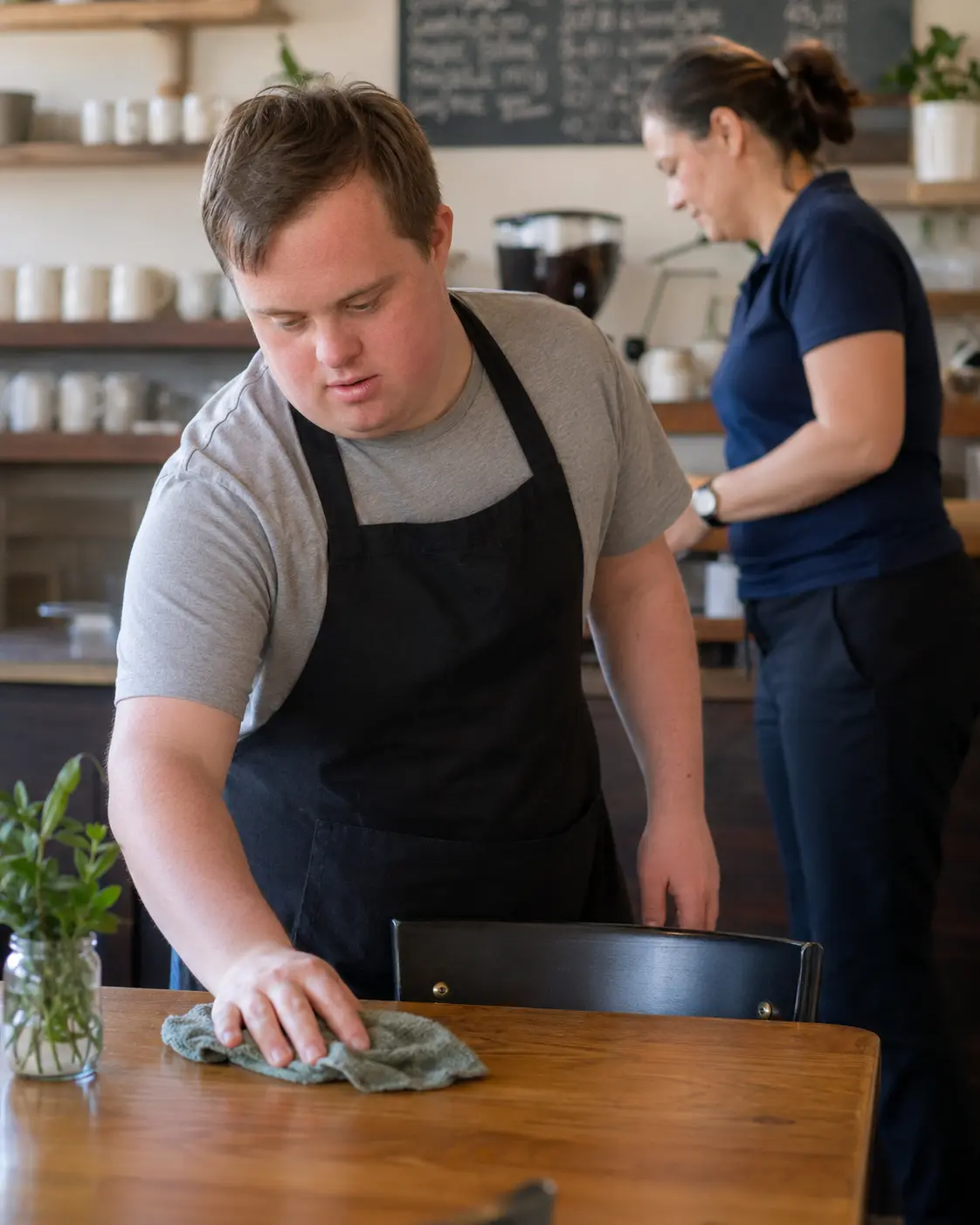
Left school unsure what he wanted to do. Tried a few work tasters — retail, kitchen work, warehouse. Hospitality clicked. We helped with his resume, practised interviews, and he now does weekend shifts at a local café. Building hours slowly.
Out of work for two years after a health change. Wanted to go back, but the confidence wasn't there. We worked on travel training, built up stamina with short volunteer shifts, and eventually she returned to admin work two days a week with planned adjustments.
Interested in IT but unsure whether study was realistic. We helped him enrol in a short TAFE certificate, supported the first few weeks of classes, and liaised with the disability support team at TAFE. Now studying full-time with a part-time work goal next year.
Finishing school?
We've got the next bit.
The jump from school into adult life is huge — suddenly, the structure disappears. For NDIS participants with a school leaver pathway in their plan, we provide the bridge between classroom and whatever comes next: work, study, volunteering, or a combination.
If you or your young person finished school recently, or is in Year 11 or 12 thinking about what's next — now is the right time to talk. Planning ahead means a smoother landing.
Who this is for
Employment and education support suits NDIS participants of any age who are exploring work, preparing for it, applying for roles, or navigating the early stages of a new job or course.
We support participants across Melbourne's eastern and south-eastern suburbs.
Capacity Building
Most employment support is funded under Capacity Building — Finding and Keeping a Job in your NDIS plan. This covers preparation, applications, and on-the-job support across your career.
We work with both plan-managed and self-managed participants.
SLES explained
SLES (School Leaver Employment Supports) is a specific two-year funding stream for NDIS participants in the first two years after finishing school. It's designed to bridge school into work or further study.
Not sure what's in your plan? Call us — we're happy to read through it with you.
Ready to explore
what's possible?
Whether you have a clear goal or are still figuring it out, the first conversation is the same — relaxed, no pressure, just a chance to talk through where you're at and where you'd like to go.